|
Disclaimer: The views and opinions expressed in these articles are those of the authors and do not necessarily reflect the official policy or position of Wrestling-Titles.com or its related websites.
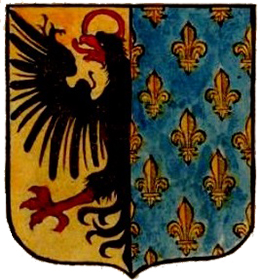
Charlemagne's Frankish Empire Coat of Arms
Netherlands / Flanders
Worstelen
- Lijfvat /Lyfvat
Standing Catch-hold of the torso above the waist
Note: Tripping is not allowed
Objective: fall on the back (“sitting” or “lying”) with (ondergooien) or without (neergooien) the attacker falling himself
- Stoeijen
Up and down
Catch-as-Catch-Can / Freestyle
Objective: "Capture" Trap Opponent on the ground (Dutch Vastleggen, Afrikaans Vasle)
France
Lutte Provencales
- Lucho de la Centure (en aut)
Standing catch-hold above the waist
Note: Tripping is not allowed
Objective: Fair Back Fall or 3 takedowns
- Lucho Libro
Up and down Catch-as-Catch-Can / Freestyle
Note: Tripping is allowed, but not favored
Objective: Fair Back Fall, originally "Capture" Trap Opponent on the ground (French Trappeur)
Germany
Ringen
- Ringen
Standing Catch-hold of the torso above the waist
Note: Tripping is not allowed
Objective: fall on the back (Niederwerfen)
- Bauern-Art Ringen, Kür-Ringen (Rangeln)
Objective: "Capture" Trap Opponent on the ground (German Unterhalten/Festhalten)
NOTE: Fair Back Fall is when two shoulders touch the ground at the same time.
There has always been a great deal of discussion about the origins and evolution of the modern internationally recognized wrestling styles such as Graeco-Roman, Freestyle and Pro wrestling. The certainty regarding the historical interrelationship between those wrestling styles (if there was such of course) was never fully established.
My fifteen-year long studies of the Western European Catch-Hold styles of wrestling which resulted in the book “The Story of Catch” helped me to answer the question regarding the interrelationship between modern wrestling styles for myself. Based on the factual historical material which I have collected, documented and thoroughly studied I came to a certain conclusion that all three mentioned above wrestling styles share historical and ethnic background. I trace the origin of modern wrestling to the Frankish folk wrestling traditions. The Franks were a confederation of Germanic tribes that was originally composed of a mix of groups settled between the Rhine and the Weser Rivers and whose name was first mentioned in 3rd century Roman sources. Throughout the Middle Ages the wrestling styles of the Franks were mainly practiced by the French (in Provence and Burgundy), German (in Franconia) and Dutch/Flemish people who all share Frankish ethnic background.
The core of the Frankish wrestling customs was that it was a catch-hold style of wrestling and it featured wrestling on the ground. Another important detail was that according to the Frankish traditions the use of legs and feet for throwing (hooking and tripping respectively) wasn’t favored and often wasn’t even considered as a “fair wrestling” and instead the “only true wrestling” was fought utilizing the strength of hands, arms, torso, hips, buttocks and back. By any other word the “Lift and Throw” techniques dominated wrestling styles of ancient Franks and the “noble art of tripping” which was a key wrestling skill in let’s say English traditional wrestling styles was neglected. The falls (preferably falls on the back, or even fair back falls) given from the standing position all were quick flying falls.
The strongest men preferred competing in a standing position with only catch-holds above the waist being allowed. They thought that those who did consider themselves to be the strongest in order to throw a man didn’t need holds below the waist, hooking, tripping nor they need wrestling on the ground.
But if the Frankish men decided to compete on a “free-for-all” conditions (catch-as-catch-can, or catch-holds of any part of the person’s body being allowed) then back fall (or a fall) wasn’t enough to win the struggle and the victor had to continue the match on the ground until his adversary quits any resistance and verbally confesses his defeat because of being “captured” (restrained in the movements and kept immovable).
Historically, according to the Western European tradition the game of wrestling was always about giving falls – throwing/taking an opponent down off his feet on his back (flying falls), or any part of his body above the knees, meaning that it was a standing wrestling.
That wasn’t an easy goal to accomplish and over the course of time this objection was simplified and the system of substituting one back fall with 3 foils (fall on any part of the body) was introduced in England and to some extent on the Continent.
This definitely put an end to the so-called “disputed falls”, which was a major issue in the standing wrestling contests for a very long time. But this innovation didn’t really fix the whole situation because under the conditions of flying falls being allowed which remained unchanged, wrestling still wasn’t a safe game, due to the nature of those falls which were violent and usually caused multiple injuries and even death.
That led to the evolution of the perception and understanding of the throw/fall itself. At some point in history the principle of ”throwing” on the back was replaced with a more progressive idea of placing on the back, pressing shoulders down, and maintaining this submissive position for certain amount of time. That was achievable only when both wrestlers were down on the ground. That is how the pinning fall was invented.
This revolutionary introduction was the birth of a new Western European tradition of ground wrestling which found its climax in the concept of a pinning fall being the only true real fall. The game is over when it’s over and one of the two is kept immovable flat on his back (controlling).
But even after the popularization of pinfalls the flying falls weren’t abolished and were still widely practiced and even preferred, it was happening first of all because of the strong association between the terms of “wrestling” and “throwing.” For centuries wrestling was thought of as throwing.
With introduction of the ground wrestling another kind of quick fall was invented, the rolling fall. For a very long time in the modern styles of wrestling (amateur and pro) all three kinds of back falls (flying, rolling and pinning) were considered legit.
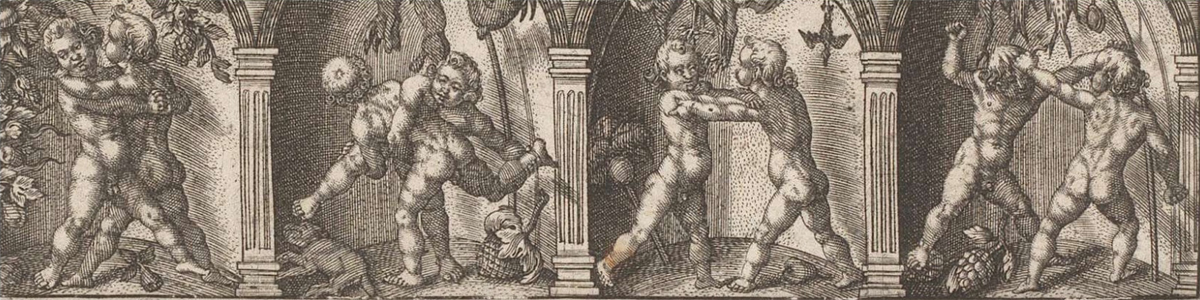 Wrestling Putti, Antoine Jacquard (attributed to), France, 17th Century
Descriptoin: Worstelen, Lijf Tegen Lijf (Wrestling, Body Against Body)The given chart shows comparative analyses of three Western European catch-hold wrestling styles of the Frankish heritage: Lutte Provencales (France), Ringen (Germany) and Worstelen (Netherlands/Flanders). Each of those extinct wrestling styles existed in two modes:
- Lijf Vatten/Bras-le-Corps/Hold Around The Waist - a standing catch-hold above the waist, use of legs and feet for throwing being prohibited
- Lijf Tegen Lijf/Corps-à-Corps/Body Against Body - an up and down catch-as-catch-can
The objective in the former style was to give opponent a quick (flying) fall from a standing position with or without attacker falling himself; such fall was either a fair back fall (two shoulders striking the ground simultaneously), or a fall on the back side of the body (including or being limited to buttocks, back, shoulders, neck), or a fall on any part of the adversary’s body except hands, knees and feet.
In the latter style the goal was to overcome an opponent on the ground, and submit him into a verbal acknowledgement of his defeat by keeping him “captured” preferably by placing him flat on his back (the safest way) or any other restricted immovable position.
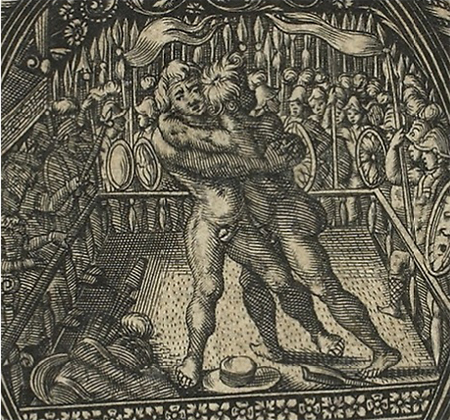 Wrestling Combat
by Jacquard, France, 17th Century
Descriptoin: Worstelen, Lijf Tegen Lijf (Wrestling, Body Against Body)In France the Lutte Provencales was still around even in the 1860s until it was completely replaced with the modern French or Graeco-Roman style aka the “flat hand” wrestling (la lutte à main plates). That newborn style was an evolved combination of both Provencal modes of wrestling (Lucho de la centure en aut and Lucho Libro). The Graeco-Roman wrestling was an up and down catch-hold above the waist, use of legs and feet for throwing being not allowed. The objective was to give opponent a fair back fall. Originally all kinds of such falls counted, i.e. flying, rolling and pinning. Now this style of wrestling is one of the two international Olympic wrestling styles.
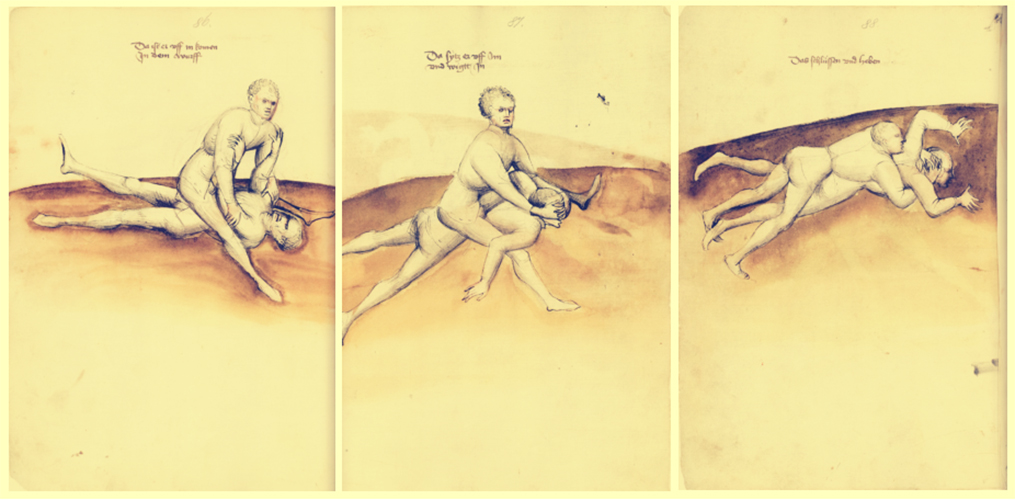 Königsegg Treatise by Hans Talhoffer, Germany, 15th Century
Winning on "capturing" opponent on the ground
Left to Right: Pinfall, Rear Face Lock, Full-NelsonMeanwhile, in Germany since the early 1800s and throughout the whole XIX century the evolved and refined variation of the Bauern-Art Ringen Rangeln (wrestling after the peasants fashion) folk wrestling style was taught at the German Gymnastic Societies (GGS). That style of wrestling was known as a Free Wrestling (Kür-Ringen). The objective in that style was to give opponent a fair back fall. Originally all kinds of such falls counted, i.e. flying, rolling and pinning. GGS or Turners popularized their style of wrestling in England as well as in the North America. Nowadays the evolved version of the GGS style of wrestling is known as Freestyle and is the second of the two international Olympic wrestling styles.
The earliest known immigration of the Flemish textile workers (aka Flemish weavers) to East Lancashire, England goes back to the 1300s. They brought to their new place their traditional rough-and-tumble wrestling style called the Stoeijen which over the time evolved there into the professional Lancashire up and down wrestling/fighting, a combative style which predated Lancashire catch-as-catch-can wrestling. In the XVI-XVII centuries French and German “weaving” Protestants who along with the Flemish fled religious persecutions on the Continent brought their old Frankish catch-hold wrestling customs to East Lancashire and West Yorkshire where they merged with the traditional English catch-hold wrestling style and over the course of centuries this combination evolved there into a new culturally unique style of wrestling the Lancashire Catch-as-catch-can. This style went through the various stages of evolution and gave birth to the modern day pro wrestling (catch) as well as it strongly influenced the current international Freestyle wrestling and different grappling styles.
This article is based on “The Story of Catch” (2019), by Ruslan C Pashayev.
Ruslan C Pashayev is an expert-member of the Traditional Sports Team of the Instytut Rozwoju
Sportu i Edukacji
(the Institute of Sport Development and Education), Warsaw, Poland.
© 2020 Ruslan C Pashayev All Rights Reserved.
|


