|
Disclaimer: The views and opinions expressed in these articles are those of the authors and do not necessarily reflect the official policy or position of Wrestling-Titles.com or its related websites.
This article is dedicated to my dear friend Bob Plantin of Burgundy (France), the owner of the French Amateur and Professional Wrestling History website.
Special thanks to French wrestling researcher and collector of wrestling memorabilia Mr. Christian Gaildraud of Étang-Salé, Reunion (late of Limoges, France) for helping me with the translations and understanding the historical materials written in French, which related to the Lutte Provencales.
The region of Midi (Southern France) a stronghold of French Huguenots was also a prominent center of Lutte Provencales (Folk Wrestling Style of Provence). The region of Provence was part of Frankish Kingdoms (at first Merovingian, then Carolingian) since the VI century. The Franks were people with Germanic origins who around 800 under the rule of Charlemagne (742-814) established the Carolingian Empire in Europe. That Empire later split into two kingdoms, East Francia and West Francia, the former became known as the Kingdom of Germany and the latter was known as the Kingdom of France. Notably, the best Graeco-Roman wrestlers came from those two countries. Flemish and Dutch people were both descendants of Franks as well.
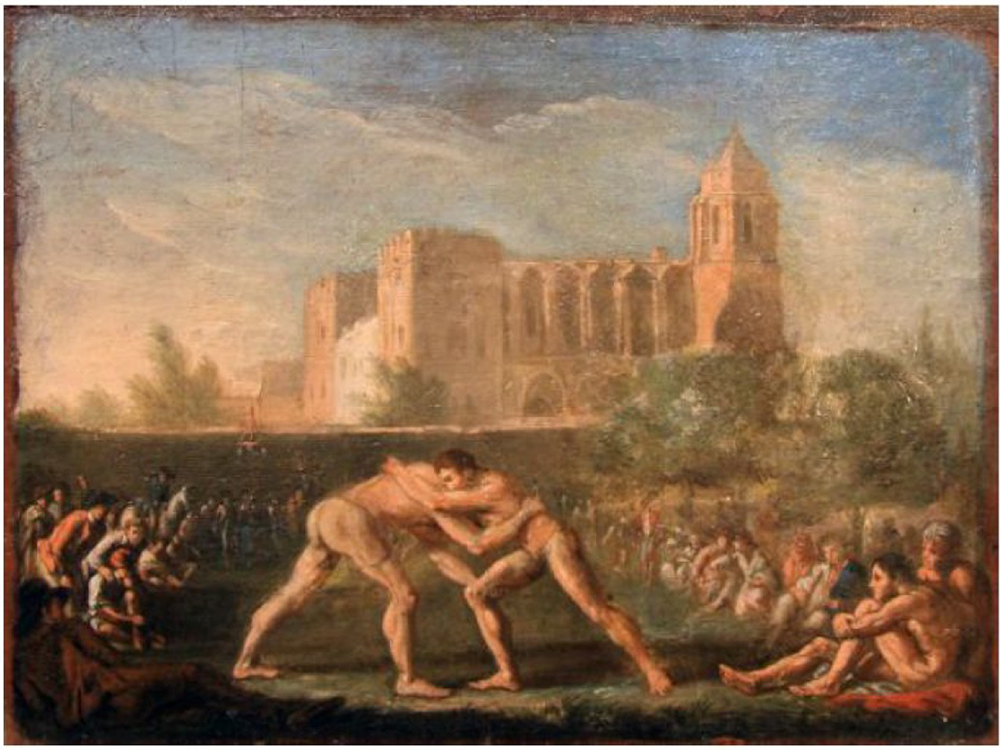 Painting: "Une Lutte d'Hommes a Montfavet" (Men's Wrestling at Montfavet)
by P. Raspay, 19th century
Lutte Libre Provencales (Provencal Freestyle Wrestling)The folk wrestling style of the residents of Provence was after the old Frankish wrestling fashion. The core of all wrestling styles of Frankish origin was a combination of catch-holds and ground wrestling. Another important detail was that just like in modern professional wrestling the “lift and throw” technique played decisive role, and the use of legs and feet for throwing (hooking and tripping techniques) was insignificant in that particular style.
Among the most famous practitioners of Frankish wrestling was fearless warrior Henry I, Duke of Guise (1550-1588) of Carolingian ancestry, who sometimes was called Le Balafré (Scarface).
The Frankish wrestling traditions were inherited by the French, German and Dutch people. Simon Goulart (1543-1628) the Medieval French humanist speaks of the contemporary wrestling customs in “Lichamelicke Sterckte” (Physical Strength) a chapter from his book called “Cabinet Der Historien“ (first published in Paris in 1600). He mentioned a certain wrestling style called “Worstelen (Worstelinge), Lijf Tegen Lijf”, or “La Lutte, Corps-à-Corps” which means “Wrestling, Body Against Body” (scuffle, free-for-all wrestling). In this style the wrestlers started their match at a distance from each other and quickly would get into close quarters and after that proceeded as they wanted. The conditions of the match were previously negotiated by the combatants. Often to take opponent down wasn’t enough in that style, the winner had to force his adversary on his back and keep him underneath thus making him quit any resistance and verbally admit his defeat. In France an old Frankish wrestling was known as the Burgundian wrestling (Lutte Bourguignonne). Historically, Burgundian wrestling was represented by two styles: Bras-le-Corps/Lijf Vatten (standing catch-hold above the waist, use of legs and feet for throwing prohibited) and Corps-à-Corps/Lijf Tegen Lijf (free-for-all close wrestling combat which usually started with the head-holds or sometimes even more “extreme” with the hair/beard holds). The former style was wrestling for a “throw” (3 falls, commonly back fall or any part of the body above the knee down) the great account of which is given in “The Travels of Leo of Rozmital, 1465-1467”; and the latter was an up and down wrestling in which the objection was to overcome your opponent on the ground. The “lift and throw” technique dominated those two styles and better developed muscles of the hip, groin and lower abdomen areas were a decisive factor. Often competitors would try to achieve a Bear Hug or a Crotch Hold on their opponent, lift him off his feet in the air, lock arms around his body and cast him down on the ground. Such Bodyslams were known as the “stones from the sky” throws (meteorite throws). Notably, use of legs and feet for throwing wasn’t favored in either of those styles, since only wrestling with hands, arms, hips and back was considered a true trial of strength and skill.
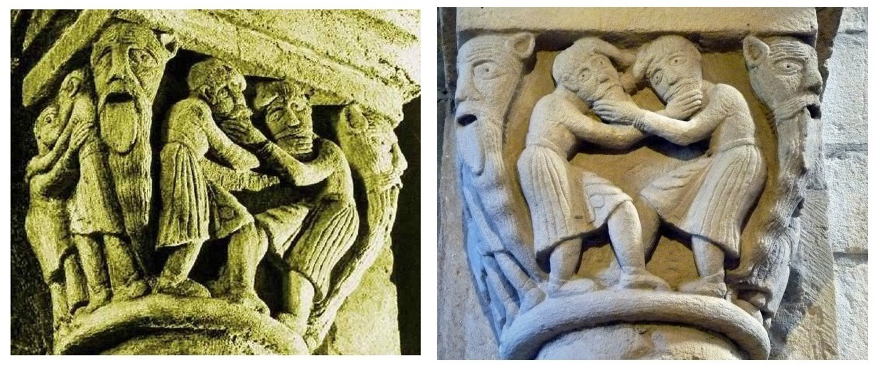 Church of Our Lady of the Assumption at Anzy-le-Duc, Burgundy, 11-12 Century
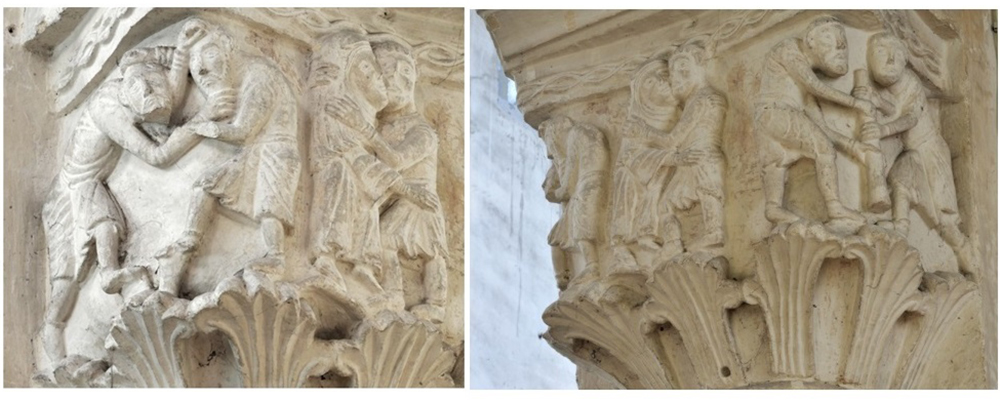 Church of St. Peter at Saint-Pierre-le-Moûtier, Burgundy, 12-13 century
The great visualizations of those two modes of wrestling are present in the form of Romanesque sculptures at Burgundian churches, such as Church of Our Lady of the Assumption at Anzy-le-Duc (9th-12th centuries) and in the Church of St Peter at Saint-Pierre-le-Moûtier (12th-13th centuries) along with a tug-of-war variation involving the wooden stick.
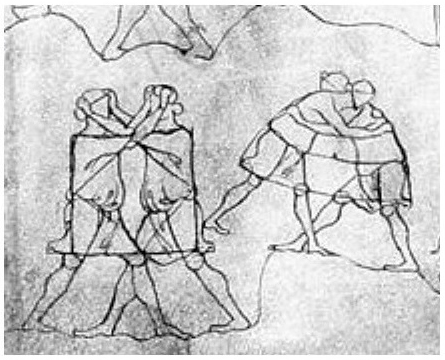 Sketch by Villard de Honnecourt, 13th century
Depictions of both those wrestling styles also could be found in a 13th century Sketchbook by the architect called Villard de Honnecourt. His name and dialect indicate that he was born in Honnecourt, a small town near Cambrai in northeastern Picardy at the frontiers of Artois and Flanders.
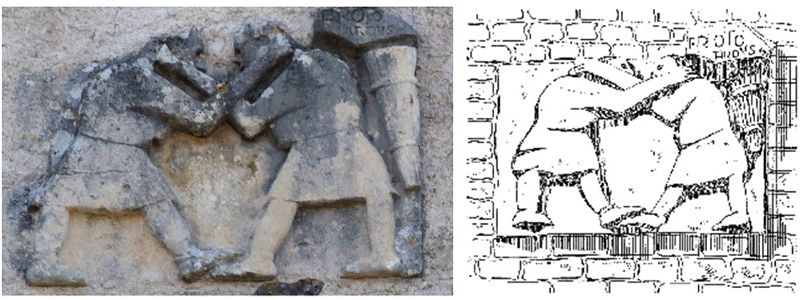 The Head-Holds Start, Church of St. Blaise of La Celle, Cher (France), 12th Century
One of the most famous portraits of the two men having a wrestling match which started with an equal “head-hold” is a bas-relief from the 12th century Church of St. Blaise of La Celle, Cher (France) by an artist called Froto Ardus. According to the famous French historian Alphonse Buhot de Kersers (1835-1897) this sculpture shows a strong resemblance with the best samples of Frankish Carolingian Art.
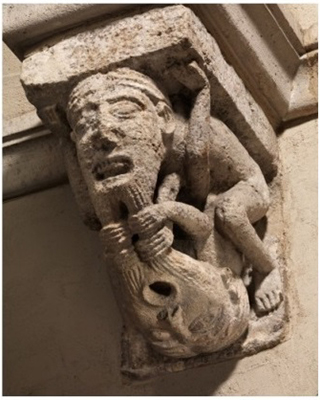 Grande-Sauve Abbey, village La Sauve, Gironde, 12-13 Century
Sculpture Description: famous beard-hold, wrestling continues on the groundA 12-13th century corbel Romanesque sculpture from the Grande-Sauve Abbey in the village of La Sauve, Gironde (France) shows typical motive of two men in beard-holds (an “extreme” variation of the head-holds) continuing their struggle on the ground.
William Caxton (1422-1491) an English writer, in his translation of French prose romance "Les Quatre Filz Aymon" mentioned two starts in Frankish folk wrestling, “at a distance” and “close equal hug.”
Probably the most descriptive accounts of historical Provencal folk wrestling were provided by Henri Rolland in his short story called “The Wrestler” from the 1st volume of "Les français peints par eux-mêmes : encyclopédie morale du dix-neuvième siècle" (1841) and in the article by Jean Brunet from the 1882 book called “Revue Des Langues Romanes.”
Various wrestling games were once in strong favor among the men of Provence. The wrestling challenge matches and elimination tournaments played an essential part in celebrations at all the folk and religious holidays called the Roumavage.
 Various holds and throws of Provencal standing catch-hold abo the waist wrestling style
Based on the traditional Provencal classification of wrestlers as per their strength there were two championship classes of local wrestlers:
1. Men’s Wrestling (Lucho dis ome) was a competition of really strong men and exceptionally strong men.
2. Half-men’s Wrestling (Lucho de miechome) was a competition of moderately strong men, young adults and youth.
There were two distinctive styles of Provencal folk wrestling:
1) Lucho de la centuro (en aut), lutte de la ceinture en haut, which was a standing catch-hold above the waist wrestling style. In this style holds of any part of the body from head to the waist including dangerous headlocks (holds around the neck) were allowed. In this style only the use of hands, arms, hips (hip lift technique) and back for throwing was legal. The objective of this wrestling style was to give the opponent a fair back fall (two shoulders touching ground simultaneously). In this wrestling style all throws were the flying falls. Often if a man was thrown down three times without a fair back fall taking place (3 foils rule) he was declared defeated. In case of both wrestlers falling to the ground without the back fall or foil being achieved (dog fall) they had to get up quickly and renew the contest.
In 1854 a noted French wrestler named M. Henrie who weighed 13st, and stood nearly 6ft in height and whose “manly form and fine proportions were pattern for a sculptor” has visited England and promoted his sport the “Mode a la Francais” (which is assumed to be the French Graeco-Roman style) at the Cumberland and Westmorland Back-Hold gathering in Newcastle upon Tyne during the Newcastle Easter Sports. According to the 1885 book called “Reminiscences in the life of Thomas Longmire (ex-champion of England)” by J. Wilson which gives a detailed account of that event French wrestling ruleset consisted of 6 articles and the last the sixth article stated: “If a man is thrown three times on one shoulder only, he must be declared beat.” Another important detail was that the wrestling matches according the French rules which M. Henrie had with English Back-Hold stars didn’t feature any ground wrestling which is an essential part of the modern Graeco-Roman wrestling. This is understandable since no Cumbrian wrestler would ever agree to have among conditions par terre wrestling . This is first of all because it’s against the common English concept of a fall (English folk Catch-Hold, Cumberland & Westmorland, Cornish & Devon) according to which the fall is possible only from the standing position, i.e. flying fall, an actual throw. The fourth article of the same French wrestling rules gives the following definition of the fall: “To be declared the conqueror, you must force your adversary’s shoulders to touch the ground.” In the 1870s the French definition of the fall (both shoulders of the fallen shall touch the ground at the same time) would be expanded by adding: “So as to be fairly seen by the public.” And soon the rule which allowed quick falls (flying and rolling falls) will be abolished. And the rule of the “3 count pinfall” which was a result of the struggle on the ground will prevail and become the only proper fall in the wrestling game. All these facts clearly show that even in the early 1850s the old “3 foils” rule of the Lutte Provencales was sometimes still in use as a part of rules of a relatively “newborn” French wrestling style which was still in transitional period of its evolution.
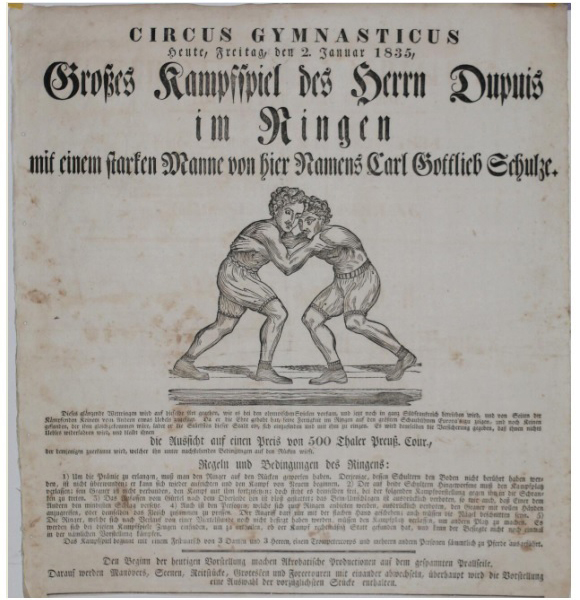
The “Rules of Wrestling” compiled by a famous French wrestling pioneer called Jean Dupuis appeared in the programme of “Circus Gymnastics” which advertised his wrestling match against a German strongman named Carl Gottlieb Schulze. That match was supposed to happen on January 2nd, 1835. The wrestling style of that contest could be simply referred to as a “Standing Greco-roman”. According to the aforementioned rules (Articles 1 and 2) the fall on both shoulders did count only in case of such throw being given from the standing position, and if it didn’t happen that particular way then the wrestler(s) had to get up and renew their contest, so to speak wrestling on the ground wasn’t allowed. “1) In order to receive an award, the wrestler has to throw his opponent onto his back. The one whose (both) shoulders didn’t touch the ground as a result of such a throw is not considered defeated; he is allowed to get up (from the floor) and start the wrestle all over again. 2) The man who is thrown on both shoulders must leave the arena.” Wrestling was allowed only above the waist,and with “flat hands”, the use of legs and feet for throwing was expressly forbidden by the rules, any unfair action was strictly prohibited. If the victory wasn’t decided in 15 mins the match was called a draw. I want to express my special thanks to my friend, a wrestling historian Mr. Michael Murphy (USA) for sharing this unique historical document with me.
 2) Lucho Libro, Lutte Libre, which was a freestyle wrestling. That style of wrestling was also known under the following names: lucha a touto lucha (lutter a toute lutte) or all-in wrestling, and lucha en arrapant pertout (lutter en attrapant partout) or catch-as-catch-can. In this style of wrestling holds of any part of person’s body were allowed. Technically any fair method of throwing was considered legal. In professional Lutte Libre the victory was decided on fair back falls only (2 shoulders touch the ground at the same time). The wrestling match consisted of a great number of unsuccessful throws (disputed falls) from the standing positions.
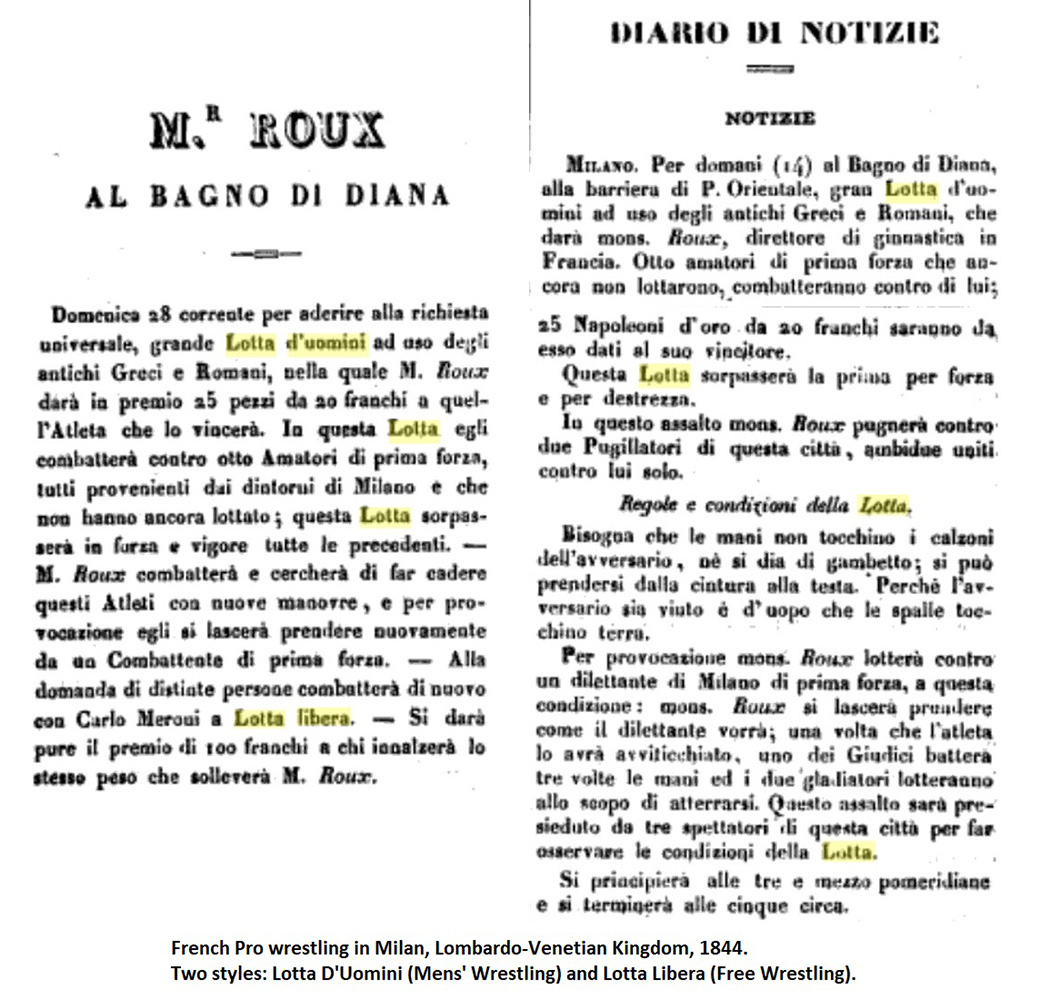
Interestingly, even before the French (Greco-Roman) style was popularized all around the world it was both traditional Provencal wrestling styles, the Men’s Wrestling and the Free Wrestling that were first exported abroad by the wrestling pioneers from Midi, France. Among such pioneers were popular French wrestlers, Mr. Roux who promoted his sport in the city of Milan (Lombardo-Venetian Kingdom), and King of Wrestlers Mr. Charles Arpin who was very active in Germany and in the United States.
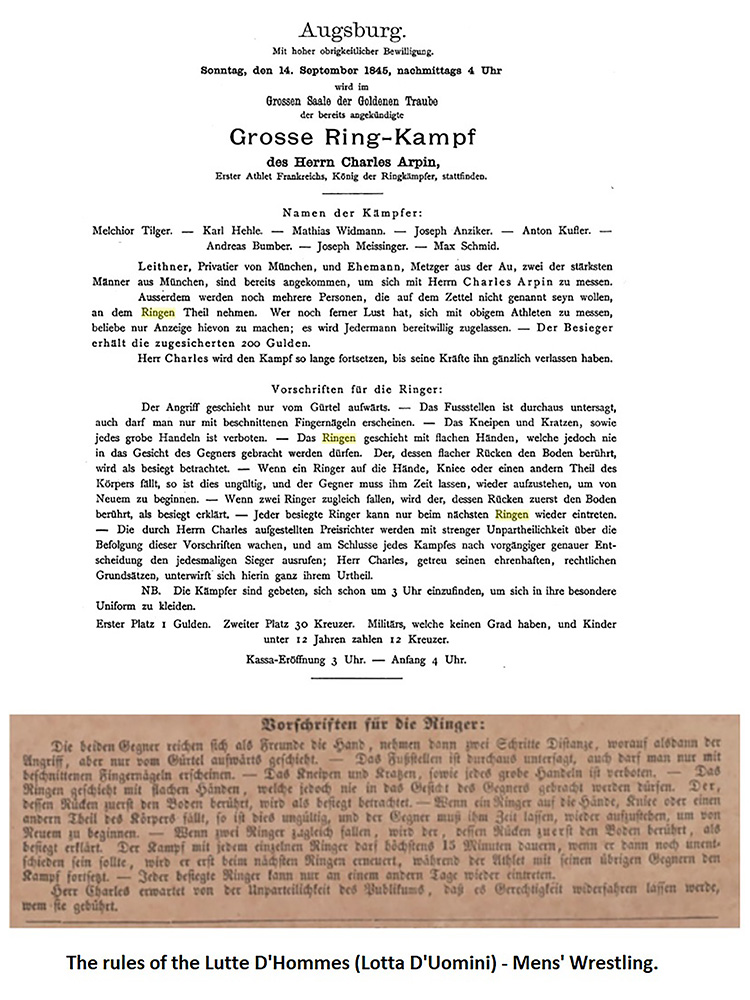
After the years of research I was lucky to finally find the unique rules of Lutte D’Hommes (Men’s Wrestling). It was a German translation of the original Provencal ruleset. Basically it was a standing Greco-Roman wrestling in which only attack above the waist is legit, and wrestling on the ground or attack on the person who was down was explicitly prohibited:
“The one whose flat back hits the ground first is considered defeated. If a wrestler falls on his hands, knees or any other part of the body, this is invalid and the opponent must give him time to get up and begin the struggle again. - If two wrestlers fall at the same time, the one whose back touches the ground first is declared defeated.” (1840s).
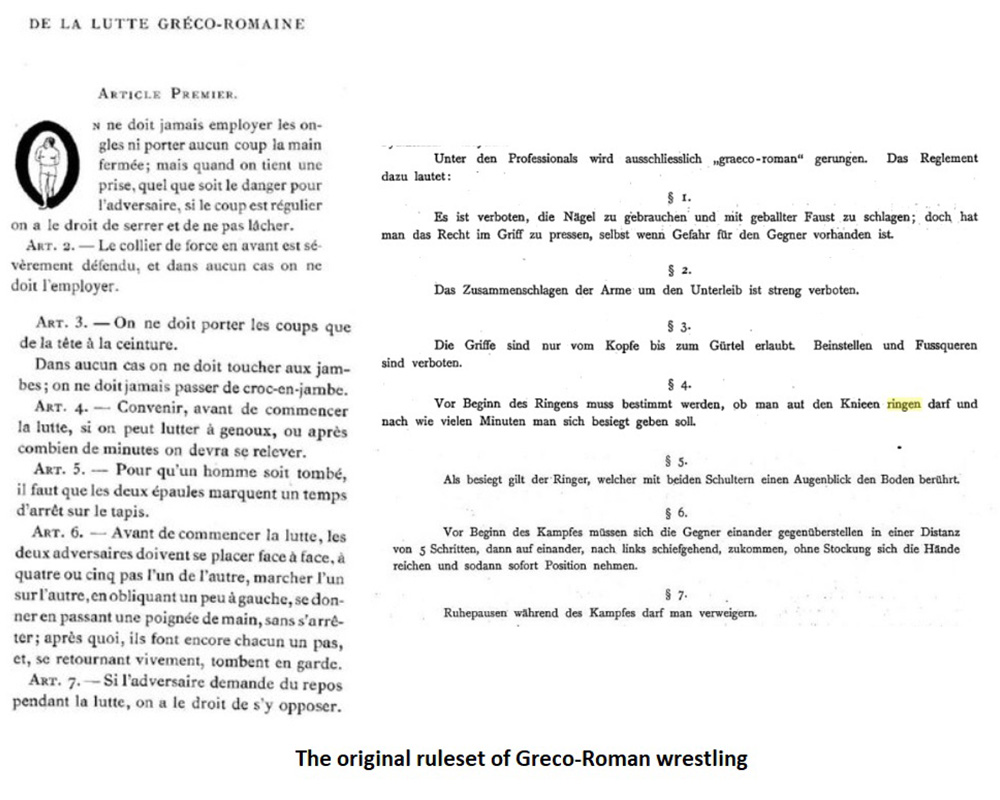
Notably, the original rules of Greco-Roman wrestling suggested that wrestlers should decide prior to the match whether they want to wrestle on the ground or not at all, and if they choose to wrestle par terre then how exactly long such wrestling is allowed to last.
Besides these two kinds of wrestling there also was another, pancratial, wrestling style which allowed ground wrestling and was known as lutto a terro. In this style if both wrestlers fell down to the ground they will have to continue their struggle on the ground until one of the two is finally placed flat on his back and kept immovable (captured) in the undermost position until he gives in and admits his defeat verbally.
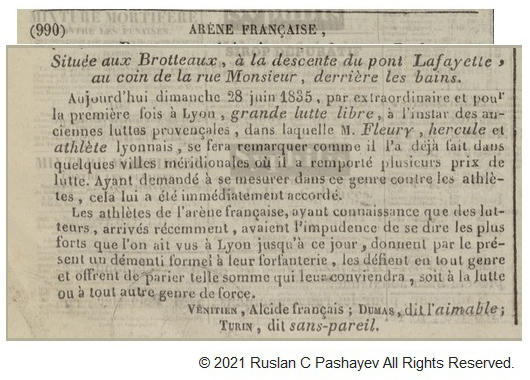 Tripping (Croc-en-jambe) was strictly prohibited in Lutte de la ceinture en haut and technically being allowed in Lutte Libre still wasn’t favored. This was based on a local stereotype of tripping being sort of an unfair action. According to their traditions tripping was thought of as a wrestling technique that didn’t exhibit strength or skill, as they felt that true wrestling was only with hands, arms, hips and back. Interestingly, a similar stereotype dominated German wrestling customs as well. Often participants of the Men’s Wrestling championships would prefer to compete in the standing wrestling above the waist style. Their logic was based on the popular opinion that a really strong man doesn’t need holds below the waist, ground wrestling, or tripping to throw his opponent off his feet and give him a back fall or at least a foil. But if wrestlers decided to compete on “free for all” conditions then back fall wasn’t enough to win the contest and the winner had to make his opponent quit the struggle and verbally confess his defeat.
Punching, kicking and any other unlawful or brutal act was strictly prohibited. In the ring wrestlers appeared stripped to the waist. Traditionally, the winners of the competitions were awarded various trophies, such as silver cups, embroidered velvet underpants fringed with gold or silver, etc.
Over the time professionalism was introduced in Lutte Provencales. Sometimes the lutte libre pro wrestling matches would turn into an all-in, rough and tumble combats of wrestling and fighting combined. In those no holds barred affairs some non-wrestlng strategies like punching with the fist and kicking were a common practice. Currently Lutte Provencales is not practiced anymore.
Another famous account which refers to the traditional wrestling style of the native residents of Provence called “Greek wrestling” or “loucho” in Provencal appeared on Pages 239-240 of the 1821 (and 1826) edition of the 3rd Volume of Statistique générale de la France (Statistique du département des Bouches-du-Rhone, avec atlas dédiée au roi) by the count Christophe de Villeneuve-Bargemon.
That paragraph gives a brief description of the wrestling match in Marseille between the two famous Provencal champions namely Peyroou of Meyrargues and Garrinet of Pertuis. This short reference is not specific regarding the holds which were allowed, but it likely was a catch-hold above the waist style of wrestling, because no holds below the waist were mentioned in that text, and as we know from the other existing accounts of Provencal style it was wrestling “above the waist” that was considered the “only true and manly wrestling”.
It’s hard to tell based on that short reference whether “tripping and hooking” (use of feet and legs for throwing) was an approved technique or not, most likely it was not, as we know it from the other existing references. Only wrestling with flat hands, arms and body was considered “manly”, though the author mentioned “legs and knees hitting against each other” during the clinch, but that doesn’t necessarily mean that the wrestlers were trying to “trip up heels” of each other. In that great trial of strength and skill there were no victors on that occasion and a 3 hour struggle between the two modern times gladiators resulted in a draw.
The rules which governed that contest were specified as such: to win a match the wrestler had to throw his opponent flat onto his back (shoulders were not mentioned in that reference at all) and keep him in that supine position for a few seconds by placing his knee on his chest in the sign of victory. Basically, the winner retains his feet after the throw, and is in full control of his opponent. It is clear from the text that wrestlers would try to avoid wrestling on the ground, though it appears that it wasn’t prohibited by the rules which stated that if both wrestlers fell together they can decide to continue their fight on the ground if they will, but as it was objectively noticed that often in that case it was not the one who performed the takedown wins, but the most agile wrestler does.
So to speak, if one wrestler realized that he couldn’t fairly throw his opponent on his back without going down himself as well, he would try to somehow throw him away from himself, or simply break away from him. Notably, very similar in this regard, are the rules of wrestling which were given by a famous French historian Charles Rollin (1661-1741) in his book on history of Ancient Greeks, except for the fact that the author claimed that “art of tripping” was a very common wrestling technique among the wrestlers of Antiquity.
In France the folk wrestling styles of the residents of Provence were still around even in the 1860s until they were completely replaced with the modern French or Graeco-Roman style, which back then was also known as a “flat hand” wrestling (la lutte à main plates).
Many of the “Protestant weavers” who fled from religious persecution, migrating from Southern France to Britain in 16th-17th centuries found their new home in East Lancashire and West Yorkshire. The waves of Flemish, German and French Protestants brought old Frankish freestyle wrestling to East Lancashire where it merged with folk English catch-hold wrestling style and over the course of centuries it evolved there into a new unique style of wrestling the Lancashire Catch-as-catch-can.
Meanwhile, on the continent, Frankish style evolved into the French wrestling, aka Graeco-Roman wrestling. Interestingly, even in the 1870s when the French style was widely exhibited in England, the most common commentary on it was that in its nature, French wrestling is very similar to Lancashire catch wrestling.
Ruslan C Pashayev is an expert-member of the Traditional Sports Team of the Instytut Rozwoju
Sportu i Edukacji
(the Institute of Sport Development and Education), Warsaw, Poland.
© 2020 Ruslan C Pashayev All Rights Reserved.
|